

Novelty, or desire to explore, is one of the most important reasons why human beings can develop to today’s prosperity, perhaps only after luck. So can it be reconciled with anti-consumerism?
Anti-consumerism requires everyone not to buy new things, just take what they already have and give full play to its value to meet the needs of your life.
The novelty is the desire to see new objects or even possess.
It seems that the two are completely opposite, so is there a solution?
I think the answer is very affirmative!
First of all, does novelty only refer to objects? Is a new love relationship novel? Is brand-new interpersonal relationship new? Is the new depth of speculation new?
Anti-consumerism is the opposite of material desire, not the love of novelty.
If you oppose novelty, it may be that the proportion of anti-humanity is a little too high. Many anti-consumerism practitioners get happiness, freedom, rather than repression and suppression.
I read a book about minimalism, which recorded a female explorer. Her backpack was minimalist, and everything was based on the minimum guarantee of survival in the wild. She is a real adventure, going where no one has ever been. If someone wants her to be a guide, she will accompany her for a fee. Ordinary people may charge $1,000, while super-rich people may charge more than $100,000, but everything must be done in her way, which is extremely simple. In the wild, you will also meet the remains of some natural dead animals, such as the heads of intact elk, which you can bring back and earn a lot of money. But she seldom picks it up, only on a whim, and the purpose is mostly to give it to a friend, not to sell it.
On her, no one will feel that she is depressed because she has no consumption, or because she is poor, she shows the strongest self-confidence and freedom. This is the final form brought by minimalism!
Second, experience rather than possession.
I have a good example here.
Derek, the manager of Suzhou Suspoke (a bespoke tailoring house), participated in the donation of dress shoes. he donated this pair of Mattina.
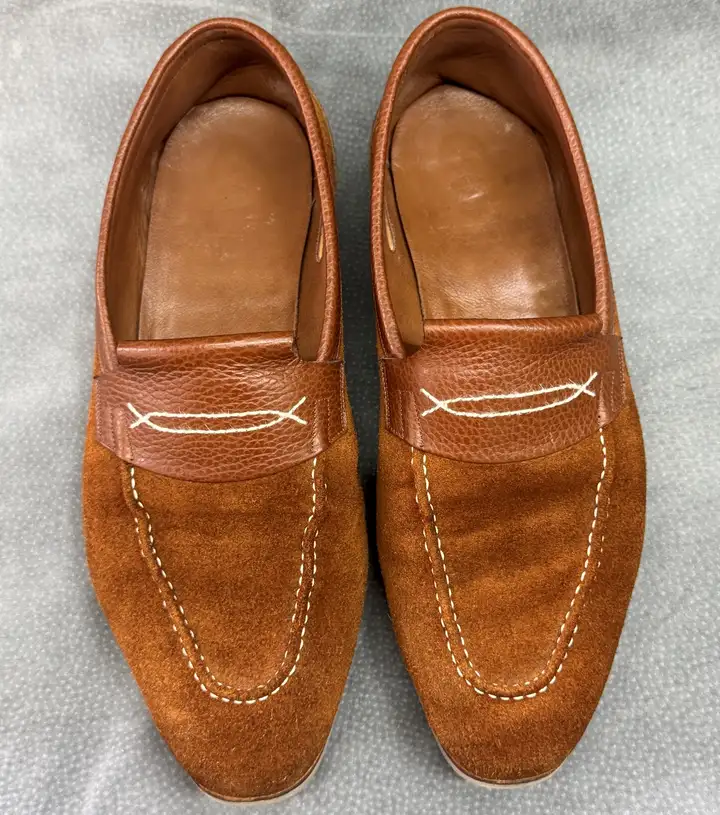
I was particularly surprised when I received the shoes!
Why? Because I have seen him 10 times, at least 9 times he wore these shoes. The shoes are in very good condition, and then they obviously fit his wardrobe very well. Why did he donate them?
He said that because he wanted to experience my loafer (my own brand fp), he replaced it.
Oh, my god, many people donate shoes, but most of them are not replacement, but upgrading or updating the wardrobe, but this kind of replacement will be the most frequently used, which is really minimalist!
And this provides an solution for reconcile anti-consumerism and novelty, that is, experience rather than possession.
In this way, we will not buy extra things, resulting in idleness and waste. In addition, things that have been experienced can continue to spread and play a role in the whole society.
Ok, let’s keep thinking, what will this behavior affect? Things are not idle, they are all circulating, so society as a whole doesn’t need so many things. So what items will be eliminated or difficult to sell? The answer is low-quality goods.
This is something I have always hated. It also uses resources and raw materials. Why do you want to make junk?
What are the main differences between low-quality goods and high-quality goods? The answer lies not in resources or raw materials, but in people’s efforts, that is, the source of product completion.
You see, in the final analysis, what are we consuming? In fact, it is still human brain and physical strength. Therefore, anti-consumerism is not so difficult to achieve, we will still consume, and we will pursue novelty, but it is more people than things.




Treating novelty as a desire that can be redirected, rather than eliminated, makes anti-consumerism feel psychologically realistic.
Fully agree with you.