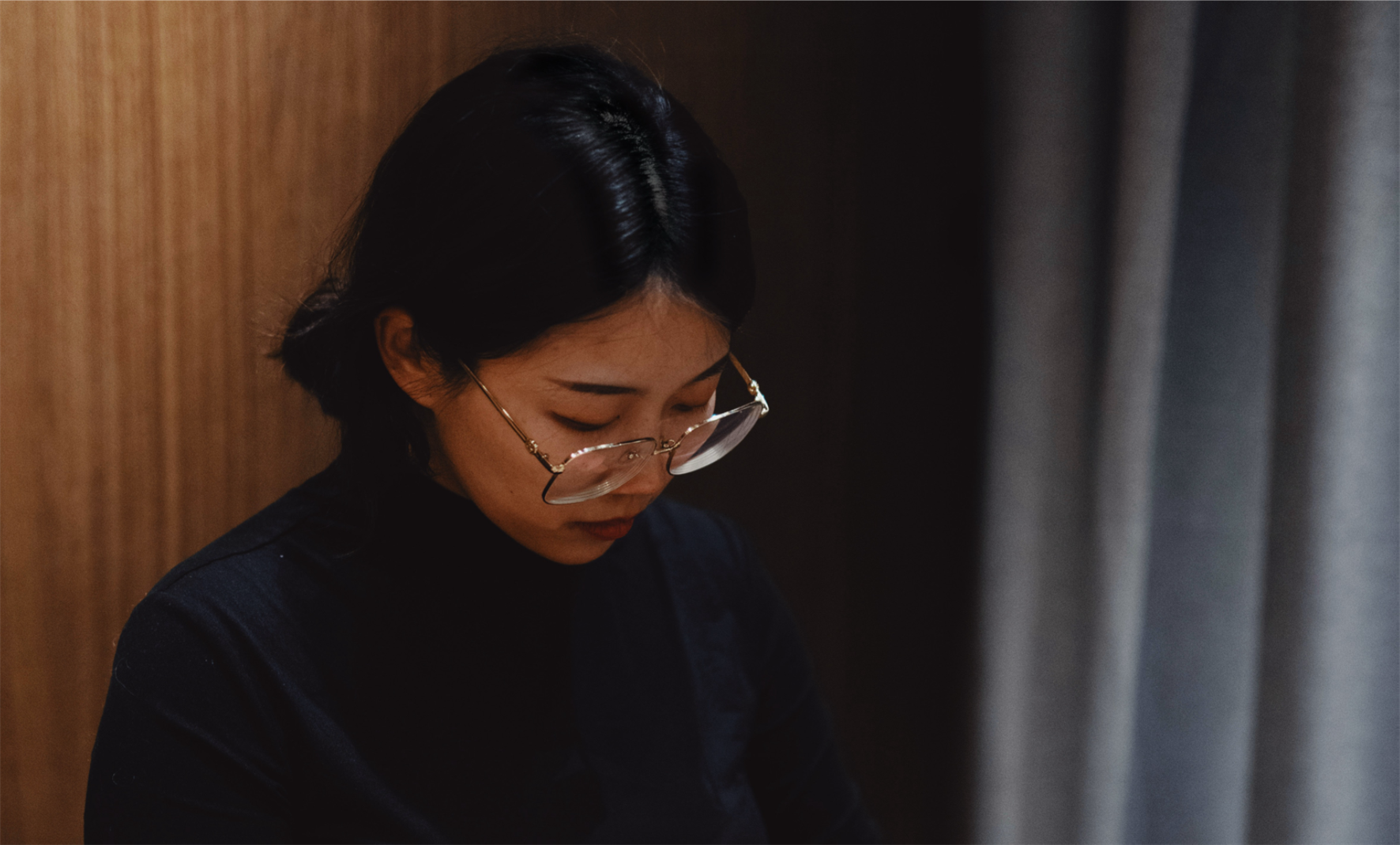
Many leather shoes lovers should have seen Huang Yan and even had a lot of contact with her. My little sister who used to be Mattina’s Shanghai store is also. I met her in 2021, when she returned to China and had not formally joined Mattina. Because of her artistic background, she joined Mattina to start her own shoemaking journey.
I contacted her several times on the way to ask about the progress and when we could try her service. The answer has always been that it will take time. Precipitation to this year, finally a little loose, accepted my interview.
Let’s learn the story of this shoemaker.
Briefly introduce yourself.

I’m from Beijing. I studied design in Beijing University as an undergraduate, and my graduate students went to Italy to study oil painting.

Although I have learned pure art, I always like to make things by hand.
What work experience did you have before making shoes?

In the past, my work was more about painting, and I received some custom paintings, and I also cooperated with my partners to receive some large murals.

How did you think of becoming a shoemaker?
After returning to China in 21 years, I happened to take part in Mattina’s offline activities and came into contact with handmade leather shoes for the first time.
Later, I went to the room where Zhao Ruoda worked. His shoes were neatly placed in rows of cabinets. When I really touched these works, I intuitively felt the goodness of these works. The overall sense of streamline and balance, the control of subtle radians in details, and the neat straight line connection, I realized at that time that this would be the benchmark I pursued.
So I decided to come to Mattina to learn how to make shoes by hand while working.
What is the journey of learning shoemaking?
My learning path begins with the most basic process at the bottom, first practicing cutting Hong Kong treasures and getting familiar with the use of knives, then stretching the last, sewing and finally finishing.

I finished making two pairs of shoes with Zhao Ruoda here. He is a very good teacher, patient and experienced. Even if there is a big mistake, he can help me save it. Worship!
In the process of making shoes, I began to become interested in things related to shoes, so I learned waxing, nursing, patina, especially patina in the gap between making shoes, which is like creating in a different medium for me to paint oil paintings.

When I finished making several pairs of shoes, I began to expect to design a pair of shoes myself and finish it.
Need to challenge new fields, design and make uppers.
Special thanks to Jaff and his shoemaker’s classroom. His studio is like a craftsman’s temple, full of tools collected by him, sewing machines of all ages and brands, shoes-making tools from all countries, and every drawer is filled with these treasures.

So, I often go to Jaff’s in the morning to learn plate making and practice sewing machines, and then go back to work in the shop in the afternoon.

He took pains to make me understand that a good craftsman should be a perfectionist first.

In the last time we left Shanghai, we designed and completed a pair of loafers together, which was a very good experience.

WM1978 was another turning point. After returning to Beijing, with the encouragement of my friends, I decided to take part in the shoe-making competition in 2025.

Teacher Cao generously shared his studio, where I tried different leather materials and last shapes, and quickly made samples for trial and error. Here I can learn from Mr. Zhou, an experienced old Baihua plate maker. For him, decades of experience has become a muscle memory, and plate making has become an instinct.

Instructed me a lot in the design of shoes. It is very touching that in this era of efficiency, they still maintain the rhythm of old-school craftsmen, and everyone focuses on doing their best work.

The dust of the shoe-making competition has settled, and this achievement is a summary of my learning process in the past two years.
What experiences have you had in learning shoemaking?
Making shoes is step by step. When you master some skills and are skilled enough, it is not difficult to finish making a pair of shoes. But there is an endless road between completion and doing well enough.

I have tried fancy design and stacked various lines and structures, but I finally understand that good shoes are first and foremost attractive, and the most conventional styles are also the most classic. Every time I go to this node, I tell myself: broaden my horizons and don’t immerse myself in my own world.
What elements and contents will you add to your shoes because of your education and work experience?

Design is rational, he solves problems, art is just the opposite, he is emotional and depends on color and media. Shoes are like a bridge that integrates many things I am good at, such as painting. Just as Cezanne uses geometric structure to be natural, I am also trying to interpret my own artistic language with traditional shoemaking techniques, leaving a little poetry in pragmatism.

In the future, I hope to try to create a special combination of upper texture, color and leather.

As a female shoemaker, what do you think are the different horizons?
As a woman, my first consideration in choosing shoes was to look good first. But many women’s shoes are actually uncomfortable, and before that, I unconsciously accepted this completely. When I start making shoes, I hope my shoes must be comfortable anyway.

In addition, gender is not the decisive factor, but different life experiences do bring unique creative perspectives. I hope I can find my own unique style on the basis of tradition.
How to describe the style of your shoes?

Smooth and full. Maybe it’s not enough now, and I’m slowly improving it. I think the arc is beautiful and can be changed more. Maybe the current work is not mature enough, but I will be close to this direction.
Is there a direction for the next evolution of shoes?
I have been making shoes for a very short time, less than two years. At present, I still focus on consolidating the foundation. The latest plan is to perfect this competition monk shoe and turn it into a pair of wearable shoes, which will also be my first design work. At the same time, I don’t want to just make formal shoes in the traditional sense. I hope I can try more pioneer designs until I find my own style.
The most concerned question: when will you take orders!
Thank you very much for your expectation! At present, we are still perfecting two basic last shapes, hoping to complete and try a small batch of appointments before autumn.

Including a foot measurement and last adjustment (MTM), for a novice shoemaker, every early guest is like a growing partner, and every feedback is that I will be my valuable experience. I look forward to starting my customized journey with such sincerity in the future.